Checking references: verify the record before formatting it
First verify that the work and its bibliographic information are real. Its author, date, title and source should allow a reader to locate it.
Web edition · 14 October 2026
A web address does not determine the type of work
A report downloaded from a website is not classified as a “web page” simply because it was found online. Choose the appropriate example for an article, book chapter, report or dataset. APA examples are organised by type of work.
A checking sequence
Open the primary record from the publishing organisation, journal or author.
Compare the title and authors with that record.
Verify the year, version and DOI, if there is one.
Match the in-text citation to its reference-list entry.
Adjust punctuation and italics for the target publication on the final pass.
Do not invent missing information
Adding a guessed year to a page with no identifiable date does not make the reference more reliable. Do not mistake placeholders in examples for real people or publications. Similarly, even if a DOI generated by an AI tool appears correctly formatted, verify that it exists.
Keep a source note
Next to the link, record your access notes and the page or section relevant to the claim. This working note may be separate from the reference entry required by your citation style. Do not confuse what readers need in a reference with your own verification notes.
Source check / web edition: 14 October 2026. Historical documents retain their own original dates.
Find the missing field before completing the reference
An absent date or DOI is not an invitation to guess. Verify the work type and primary record first, then use the missing-information rule for the required style. The records below are fictional and are not real publications.
Check author, date, title and source separately in the work and the publisher’s record. A website footer’s copyright year need not be the publication date of the particular work.
If no date is available, use the required style’s no-date notation instead of replacing it with the current year. Keep your access note separate. The target journal may require a different language or style adaptation.
Include a DOI only when verified for that work in the original or publisher record. Do not borrow one from a similar title. “DOI not found” is different from establishing that none exists.
Check the in-text citation and reference together. For a missing author or title, use the style’s applicable example. If the source itself cannot be found, do not invent fields to make it look like a real publication.
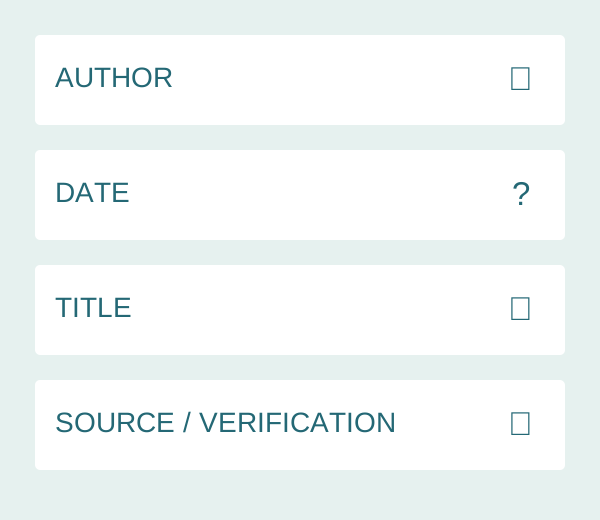
AUTHOR · DATE · TITLE · SOURCE / VERIFICATION. Sources: APA Style — missing information
Field
Example or check
Fictional record A
Organisation: Example Research Unit; title: Open data note; date: not found; source: training record. No real institution or publication is claimed.
Correction A
APA’s English examples use n.d. for no date. Check the target publication’s adaptation; do not guess 2026.
Fictional record B
Author and year present; DOI unverified. Check the publisher record rather than generating an identifier; keep the verification result in a working note.
Two separate dates
Publication date: the date stated for the work. Access date: when you opened the record. They are not the same field.
Checking card
Work type __; author __; date/missing field __; title __; source __; verified DOI/URL __; access note __; target style __; open question __.
Use this card to inspect a reference manager’s output too. Correct punctuation does not prove that a source exists or supports the claim you are making.