ELYADAL web edition ·
Read Escher through a repeat you can test
Start with what you can see. Then test one transformation and keep the historical document separate from your own explanation.

Original exercise: a 4 by 3 grid of two-centimetre squares, 8 by 6 centimetres overall. Twelve square tiles cover 48 square centimetres; the small triangles are markings.
1. Locate the text and keep its authorship
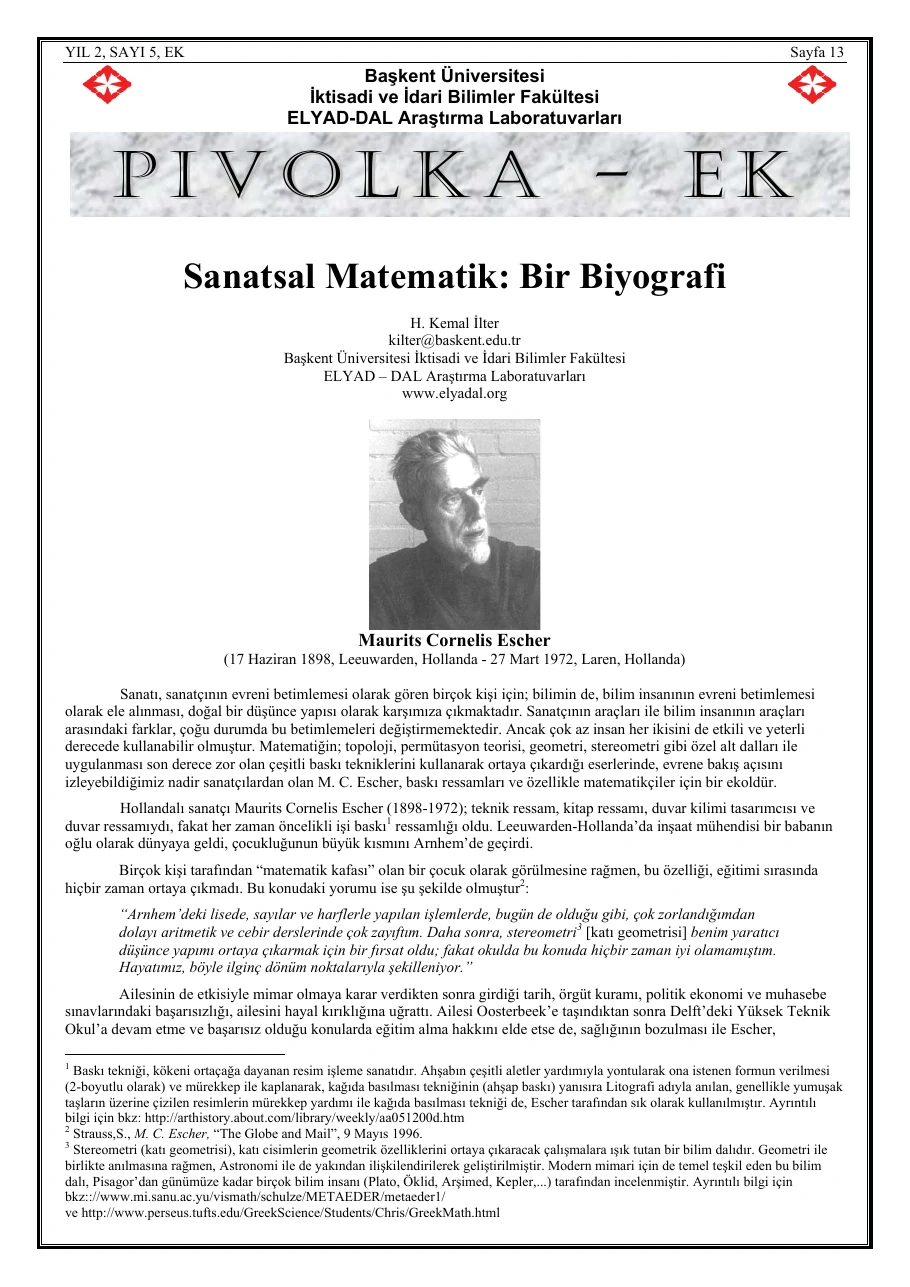
H. Kemal İlter’s Sanatsal Matematik: Bir Biyografi is the separate supplement to PiVOLKA 05, whose issue masthead gives March 2003. The supplement has nine PDF pages. The archived edition cited here uses printed pages 13–21; the separately hosted university-mirror copy numbers the same supplement 1–9. The main issue PDF has 12 pages; the supplement is already preserved separately in this archive. It is not an additional 2026 issue.
The first pages connect Escher’s biography with the regular division of the plane. Later pages discuss repeated motifs, spatial illusion, printmaking and references. This new reading exercise follows those themes; it is not a complete English translation or a new work by İlter. The source remains Turkish.
2. Separate an observation from a biographical claim
Choose one reproduction in the supplement. Describe only what is visible before explaining it. “The motif repeats across the surface” is an observation. An assertion about the artist’s intention needs a documented statement. A date, title, medium or biographical event needs its own source as well.
In the archived edition, use printed pages 13–14 for the opening biography; 15–16 for regular division and repeated motifs; 17–19 for spatial and visual themes; 20 for references and another reproduction; 21 for the appendix images. A PDF page number and a printed page number are different: PDF page 3 is printed page 15 in the archived edition and page 3 in the university-mirror copy.
3. Try a repeat that you can verify
Original exercise: draw a square grid with 4 columns and 3 rows. Each square is 2 cm wide. Mark the same small triangle in the upper-left corner of every square. Copy it by sliding the square without turning or flipping it.
The panel is 8 cm wide and 6 cm high. It contains 12 squares and has area 48 cm²: 4 × 3 × 2 × 2. Each copy is translated by a multiple of 2 cm horizontally and vertically. The square boundaries meet without gaps or overlaps. A coloured triangle alone does not cover the plane; the square is the tile in this example.
Now rotate just one triangle by a quarter turn. The square grid still tiles the panel, but the marked motif no longer has the same orientation. Record what changed rather than calling every repetition the same symmetry.
This geometric diagram is newly drawn by ELYADAL. It is not an Escher artwork or a reproduction of one of his designs. The observation task can be done on paper without sending information to the site.
4. Check a historical caption before reusing it
An old caption is a source to investigate. It is not automatically authoritative for every date or technique. The supplement labels Metamorphosis I as 1933. Escher in The Palace’s collection article dates it to May 1937. Keep the 2003 source intact, but use the verified collection record for the work’s date in a new caption.
For contemporary interpretation, Escher in The Palace’s Mirrored illusions discusses repetition and reflection, including the possibility that apparently matching halves differ. Use a museum or collection record when you need a precise work title or technique. Do not infer a printmaking method from a small scan alone.
5. Finish a usable reading note
- Name the document, author and printed page.
- Write one visible feature, without a claim about intention.
- Name the transformation you actually tested.
- Record your dimensions and calculation.
- Mark the historical detail that still needs verification.
Completed example: “PiVOLKA 05 supplement, İlter, printed page 15. Observation: repeated figures cover a surface. My exercise: 12 square tiles cover an 8 × 6 cm panel; each translation is a multiple of 2 cm. Limit: the exercise does not reconstruct the artist’s design or prove a biographical claim.” Continue with the main issue and preserved supplement.
Make your own record
Download the blank CSV and fill it on your own device. Completed records are not sent to this website. You can also copy the headings onto paper.
Download the blank CSV worksheetOpen the completed example record
- Document
- PiVOLKA 05 supplement
- Author
- H. Kemal İlter
- Printed page
- 15; PDF page 3
- Observation
- Repeated figures
- My calculation
- 4 × 3 × 2 × 2 = 48 cm²
- Limit
- Not a reconstruction of an artwork
Sources and reading limits
H. Kemal İlter · Sanatsal Matematik: Bir Biyografi · PiVOLKA 05 supplement · March 2003. The original document and the new editorial exercise are distinct. An archive capture date is not a publication date.
- PiVOLKA_05_05.pdf
- Escher in The Palace · Metamorphosis I, II, III
- Escher in The Palace · Mirrored illusions
No new expert review or measured outcome is claimed.
Inspect the original page facsimile